Páginas

quinta-feira, 30 de agosto de 2012

Ilhas Cook - 5 & 10 Dollars Nicolaus Copernicus


Ano: 2008
Valor facial: 5 Dólares
Diâmetro: 38,61 mm
Metal: 925/1000 Ag
Qualidade: Proof (c/ cristal)
Peso: 25gr.
Tiragem: 2500 pçs


Ano: 2008
Valor facial: 10 Dólares

Diâmetro: 13,92 mm
Metal: 999.9/1000 Au
Qualidade: Proof (c/ cristal)
Peso: 1.24gr.
Tiragem: 7500 pçs

 Premium Set Nicolaus Copernicus
Amazing gold (partly silverplated) and silver (partly goldplated) coin issued by the Cook Islands in 2008. The coin reverse depicts an effigy of polish astronomer and scientist Nicolaus Copernicus and the legend "Nicolaus Copernicus" (name also written in polish),"Stellarium", dates "1510 - 1583" and the year of issue. The coins also depicts the planetarium with Swarovski crystal placed in the middle. The coin obverse depicts the effigy of the Queen Elizabeth II. and the denomination.
These coins are delivered in luxury dark-brown wooden case along with the certificate of authenticity.

Nicolaus Copernicus
Nicolaus Copernicus (German: Nikolaus Kopernikus; Italian: Nicol? Copernico; Polish: Mikołaj Kopernik; in his youth, Niclas Koppernigk; 19 February 1473 – 24 May 1543) was a Renaissance astronomer and the first person to formulate a comprehensive heliocentric cosmology which displaced the Earth from the center of the universe.
Copernicus' epochal book, De revolutionibus orbium coelestium (On the Revolutions of the Celestial Spheres), published just before his death in 1543, is often regarded as the starting point of modern astronomy and the defining epiphany that began the scientific revolution. His heliocentric model, with the Sun at the center of the universe, demonstrated that the observed motions of celestial objects can be explained without putting Earth at rest in the center of the universe. His work stimulated further scientific investigations, becoming a landmark in the history of science that is often referred to as the Copernican Revolution.
Among the great polymaths of the Renaissance, Copernicus was a mathematician, astronomer, jurist with a doctorate in law, physician, quadrilingual polyglot, classics scholar, translator, artist, Catholic cleric, governor, diplomat and economist.
Nicolaus Copernicus was born on 19 February 1473 in the city of Toruń, in the province of Royal Prussia, in the Crown of the Kingdom of Poland. His father was a merchant from Kraków and his mother was the daughter of a wealthy Toruń merchant. Nicolaus was the youngest of four children. His brother Andreas (Andrew) became an Augustinian canon at Frombork (Frauenburg). His sister Barbara, named after her mother, became a Benedictine nun and, in her final years (she died after 1517), prioress of a convent in Chełmno (Culm, Kulm). His sister Katharina married the businessman and Toruń city councilor Barthel Gertner and left five children, whom Copernicus looked after to the end of his life.
Copernicus never married or had children. "Towards the close of 1542, he was seized with apoplexy and paralysis." He died on 24 May 1543, on the day that he was presented with an advance copy of his De revolutionibus orbium coelestium.

segunda-feira, 25 de junho de 2012

Polónia - 10 zl Augusto de 1980


Ano: 2010
Valor facial: 10 zl
Diâmetro: 32 mm
Metal: 925/1000 Ag
Qualidade: Proof (pintura vermelha)
Peso: 14,14gr.
Tiragem: 50000 pçs


Obverse: At the top, against the background of the Polish flag with a stylised inscription: SOLIDARNOŚĆ (Solidarity), an image of the Eagle established as the State Emblem of the Republic of Poland. On the left side of the Eagle, inscription: 10 ZŁ, on the right, the notation of the year of issue: 2010. In the centre, against the background of the stylised images of people with their arms raised in a gesture of victory, a separated round surface with the logo of the 30th anniversary of the formation of the Independent Self-governing Trade Union “Solidarity”. Around the logo, inscription: RZECZPOSPOLITA POLSKA (Republic of Poland). The Mint’s mark: M/W under the Eagle’s left leg.
Reverse: In the centre, against the background of letter S in which images of people with their arms raised in a gesture of victory were placed, stylised inscription: 1980, vertically. On the left-hand side, inscription: POLSKI (Polish), on the right-hand side, inscription: SIERPIEŃ (August).

Polónia - 10 zl 60º Aniversário do Fim da 2ª Guerra Mundial


Ano: 2005
Valor facial: 10 zl
Diâmetro: 32 mm
Metal: 925/1000 Ag
Qualidade: Proof (pintura verde)
Peso: 14,14gr.
Tiragem: 70000 pçs


Obverse: At the top, a semicircular inscription, RZECZPOSPOLITA POLSKA, below, an image of the Eagle established as the state emblem of the Republic of Poland. Below, stylised figures of soldiers of different military formations. At the bottom, a notation of the year of issue, 2005, and below, an inscription, 10 Z¸. The Mint’s mark, m/w, under the Eagle’s left leg.

Reverse: At the top, a semicircular inscription, 60. ROCZNICA ZAKO¡CZENIA, below, II WOJNY / ÂWIATOWEJ. Below, stylized: the ruins and the pigeon with the olive branch in its beak. On the left–hand side, an inscription, 1945.

domingo, 20 de maio de 2012

Holanda - 5€ 400º Aniv. das Relações Diplomáticas da Holanda com a Turquia


Ano: 2012
Valor facial: 5 Euros
Diâmetro: 29 mm
Metal: CuNi Prata (banho)
Qualidade: BU
Peso: 10,5gr.
Tiragem: 15000 pçs


The Royal Dutch Mint have announced (29th February) their first commemorative coins for 2012, and the theme for the new 5 and 10 Euro coins is friendship between nations. Commissioned by the Ministry of Finance, the Royal Dutch Mint will strike the new commemorative gold and silver coins with the theme “400 years of diplomatic trade relations between the Netherlands and Turkey.” The First Strike of the coin will take place on the 26th of March.
The first trading links between the Netherlands and Turkey stem from the Middle Ages, when the Dutch were journeying to the Holy Land and visited Turkey as religious pilgrims. The first Dutch ambassador, Cornelius Haga, arrived in Istanbul in 1612 and diplomatic relations were firmly established. Consequently, in the sixteenth century, the Tulip which was to become synonymous with Dutch identity was exported from Turkey to Europe. This import lead to the Tulip-mania in the Netherlands and eventually the tulip became a national symbol.

As part of this history between the two nations, the obverse design of both coins includes a portrait of Queen Beatrix along with a luxuriant flowering tulip, again serving as the national symbol. On the reverse, a closed tulip can be seen in combination with the national emblem on the Turkish flag, as a metaphorical image of the tulip’s native origins. The denomination of five (or ten) Euro appears just under the stem.

domingo, 22 de abril de 2012

Áustria - 25 €uro Bionics


Ano: 2012
Valor facial: 25 Euros
Diâmetro: 34 mm
Metal: 900/1000 Ag & 6,5gr Niob
Qualidade: proof
Peso: 16,5gr.
Tiragem: 65000 pçs


Um lado da moeda mostra um corte transversal da concha do Nautilus. A sua concepção é frequentemente utilizada como um modelo de aresta de corte, e mais espectacular, edifícios. Este lado da moeda mostra também três outros exemplos em que as soluções da natureza agem como um protótipo para a tecnologia moderna. Acima do Nautilus voa uma águia, enquanto na parte inferior esquerda uma flor de lótus simboliza o efeito lótus. O outro lado da moeda chama a atenção para o uso da Biónica na arquitectura. Ao fundo, uma perspectiva interior do estádio Olímpico de Munique, o telhado do qual foi concebido com base nos achados de Biónica.
Esta moeda, tal como a moeda Niobium emitida em 2010 e dedicada às “Energias Renováveis” faz parte do programa Marvin em favor do meio ambiente. A Marvin vai devolver parte dos lucros obtidos com a venda desta moeda para iniciativas ambientais


segunda-feira, 12 de dezembro de 2011

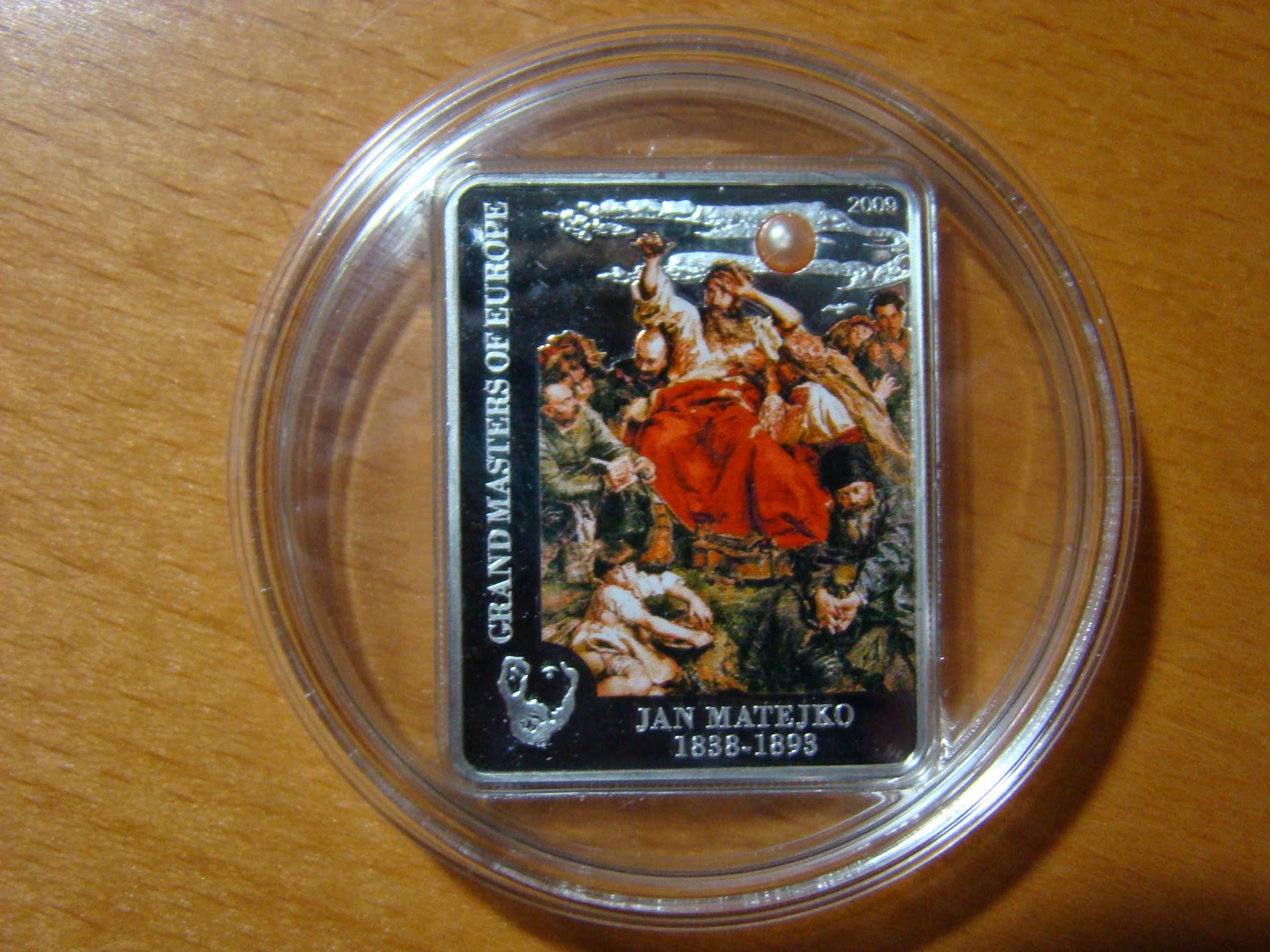
Ilhas Cook - 5 Dollars "Old Masters of Europe" Jan Matejko


Ano: 2009
Valor facial: 5 Dollar
Diâmetro: 30x38 mm
Metal: Prata (.925)
Qualidade: Proof (inc. perola)
Peso: 25gr.
Tiragem: 5000 pçs

Cook Islands issued this special coin with an authentic pearl inlaid. Jan Matejko, the most popular creator of romantic visions of Polish history, declared, "Art is a weapon of sorts; one ought not to separate art from the love of one's homeland." This beautiful coin is the second of the series "Old Masters of Europe" and is dedicated to his masterpiece, featured by a real inlaid pearl. The coin obverse depicts his famous painting Wernyhora, with a pearl representing the sun. The reverse depicts Queen Elizabeth II’s profile. Jan Matejko was born in 1838, in Kraków. He was a Polish painter known for paintings of notable historical Polish political and military events. His most famous works include oil on canvas paintings of numerous battles and court scenes, and a gallery of Polish kings. He is counted among the most famous Polish painters. Almost everyone in Poland is, in a sense, brought up on Matejko's large historical paintings. Disseminated in thousands of reproductions, they have for generations, helped the young and some not so young visualize salient events in the history of the nation. To understand the genesis of such historical paintings it should be recalled that at the time in the 19th century when Matejko created these canvases, the Polish lands were partitioned between Russia and Prussia, which morphed into Germany and Austria. In the lands occupied by Russia and Germany, strenuous efforts were made by the occupying powers to stamp out Polish culture. The use of the Polish language was forbidden in schools and to hinder transmission of knowledge about the country's proud history, censorship existed that effectively banned publication of textbooks and the like that dealt with the subject. In these circumstances, historical paintings which could be used as a way of transmitting such knowledge assumed an importance and relevance otherwise seldom accorded to them. Matejko, a fervent Polish patriot, devoted much of his talent to this cause.

Ilhas Cook - 5 Dollars "Old Masters of Europe" Johannes Vermeer


Ano: 2009
Valor facial: 5 Dollar
Diâmetro: 30x38 mm
Metal: Prata (.925)
Qualidade: Proof (inc. perola)
Peso: 25gr.
Tiragem: 5000 pçs

The Cook Islands issued this special coin with an authentic inlaid pearl. Johannes Vermeer was a Dutch Baroque painter who specialized in exquisite, domestic interior scenes of ordinary life. Vermeer worked slowly and with great care, using bright colors, sometimes expensive pigments, with a preference for cornflower blue and yellow. He is particularly renowned for his masterly treatment and use of light in his work. This beautiful coin is the first of the series "Old Masters of Europe" and is dedicated to his masterpiece. The obverse depicts Queen Elizabeth II’s profile. The painting “Girl with a Pearl Earring” (Dutch: Het Meisje met de Parel) is one of Vermeer's masterpieces and as the name implies, uses a pearl earring for a focal point. The painting is currently housed at The Mauritshuis in The Hague. It is sometimes referred to as "the Dutch Mona Lisa.”